WAL Cake is a Go service that copies row changes from Postgres to Parquet files in S3, one folder per day, to build a data lake. Postgres sends those changes as one ordered stream. The consumer confirms its progress with a single position, which means “everything before this is safe”. The slow work in between, encoding Parquet and uploading to S3, can run in parallel. This post shows how WAL Cake does that while it still reads and acknowledges the WAL in order, how it is tested, and where it can still replay or stall.
I wrote most of WAL Cake, and we ran it in production at a large Indian fintech
company. Everything in this post refers to commit
300e7ab.
The benchmarks ran on an Apple M3 Max with Go 1.26.5, and the integration
tests against Postgres 18.
Terms #
If you already know Postgres logical replication, skip to the rule.
- WAL (write-ahead log): Postgres records every change in this log before it writes the change to the table files.
- LSN (log sequence number): a byte position in the WAL. A higher LSN means a later change.
- Replication slot: a bookmark in the WAL for one consumer. Postgres keeps the WAL that the consumer still needs, so it can resume after a crash.
confirmed_flush_lsn: the slot’s bookmark. The consumer moves it by sending an LSN back to Postgres. This message is the ACK. On restart, Postgres does not resend transactions that committed before this position.- pgoutput: the built-in plugin Postgres uses to stream row changes to a consumer.
- CDC (change data capture): reading these row changes and copying them to another system.
- Parquet: a columnar file format used by data lakes.
The figures use one colour code: black is structure, brown is data, green is durable, red is a problem, purple is the part to look at, blue is an option, and orange is the option we chose.
The rule #
WAL Cake builds the raw layer of a data lake. It reads committed row changes,
writes them to S3 as Parquet files, and tells Postgres which WAL it can delete.
Each file holds rows from one UTC commit day, under a YYYY/MM/DD prefix. A
query or a daily job for one day reads one prefix and filters out nothing.
A row is safe in Postgres after commit. A file is safe in S3 after PutObject
returns. Between the two, WAL Cake holds rows only in memory. If it crashes,
Postgres must still have every row that is not yet in S3. So the consumer
follows one rule:
Advance the slot only past rows that are already in S3.
Existing options #
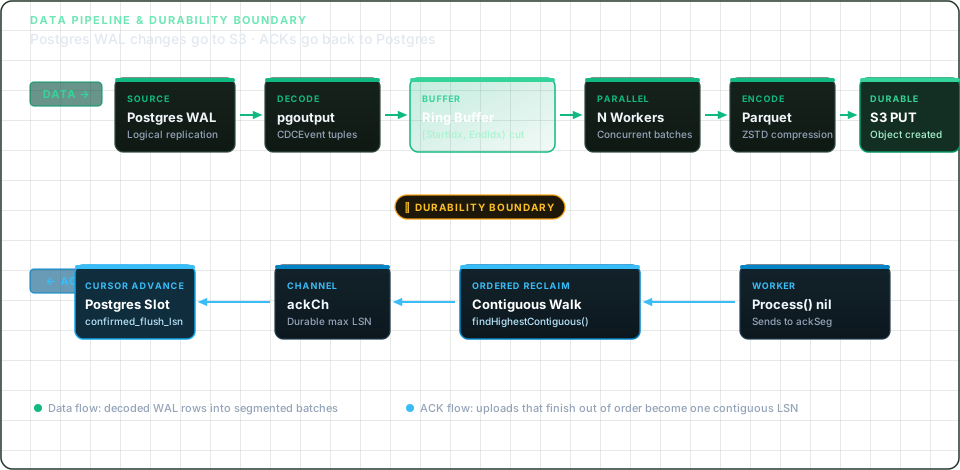
Every option follows the same rule. They differ in which system tracks the slot position, and in how much control you get over the files.
- Debezium with Kafka Connect reads pgoutput1 and stores its position in Kafka. An S3 sink connector writes the files and can partition them by time. This is a good fit if you already run Kafka.
- Debezium Server runs without Kafka2. It has sinks for Kinesis, Pub/Sub, HTTP, and more, and a community-maintained Iceberg sink, but no sink for plain Parquet files in S3.
- AWS DMS is a managed service that writes Parquet to S3 and can put files in folders by transaction commit date3. You configure it instead of writing code, and you run a replication instance.
- Direct pgoutput is what WAL Cake does. One Go process reads pgoutput, batches rows, writes Parquet, and uploads it.
We chose direct pgoutput because we wanted day-split Parquet files from one Go binary, without a broker or a replication instance, and with control over batch size and the ACK. In exchange, we are responsible for reconnects, backpressure, and the ACK. This post is about the ACK.
Why one upload at a time is too slow #
The simplest correct consumer does this in a loop:
- Encode a batch of rows as Parquet.
- Upload it to S3 and wait.
- Send the batch’s last LSN to Postgres.
This follows the rule, because nothing is confirmed before it is in S3. But the worker is idle during step 2, so S3 latency limits the throughput.
An S3 PUT from inside the same region usually takes tens to a few hundred milliseconds. One public benchmark of 500 KB PUTs measured a median of 70 ms and a p99 of 137 ms4. The estimate below uses 100 ms:
B = events per batch             1,000    (default)
E = Parquet encode time          0.0012 s (benchmark below)
P = S3 PUT time                  0.100 s  (assumed)
R = incoming events per second   10,000

one worker handles   B / (E + P)       = 1,000 / 0.1012      ≈ 9,881 events/s
workers needed       ceil(R × (E+P)/B) = ceil(10,000 × 0.1012 / 1,000) = 2
At 100 ms, one worker handles about 9,900 events/s, so at 10,000 events/s the backlog grows by about 120 events every second and never shrinks. At 200 ms, three workers are needed. The worker count is a setting; the default is four5. Use the figure below to try other values.
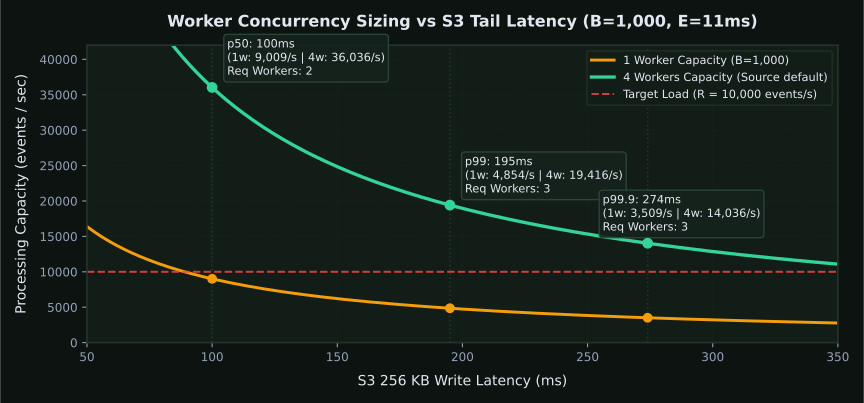
ceil(R × (E + P) / B). The orange curve is the capacity of the workers you run. Move the cursor to evaluate any point, or change B and E to move the bands.This is an upper bound: it assumes full batches and no retries. More workers do not make one upload faster. They let other uploads run while one waits.
Which steps can run in parallel #
The WAL must be read in order, and the ACK must be sent in order. Each step of the pipeline, in order:
- Reading is one stream. Only one connection can read from a replication slot at a time6, and Postgres sends each transaction after it commits, in commit order. You could create one slot per group of tables and read them in parallel. But each slot decodes the whole WAL on the Postgres server, you lose ordering across tables, and you have more slots to monitor.
- Parsing and decoding are fast. WAL Cake parses a pgoutput insert and turns five columns into a Go map in about 0.5 µs, so 1,000 rows take about 0.5 ms.
- Encoding and uploading the same 1,000 rows take about 101 ms with the numbers above. Almost all of it is waiting for S3.
- The ACK is one number, sent on the same replication connection.
So WAL Cake keeps one reader and one ACK, and runs only encode and upload in parallel:
one reader  →  cut into segments  →  N workers: encode + upload  →  one ACK
(in order)                           (finish in any order)           (in order)
Amdahl’s law gives the limit. Per 1,000 rows, the serial part takes about 0.5 ms and the parallel part about 101 ms, so the serial part is about 0.5% of the work. In theory, the single reader becomes the limit only at around 200 workers. In practice, other limits come first: memory per worker, and the walsender, the single Postgres process that decodes the slot. I have not measured the walsender’s ceiling. The 0.5 µs is for a short five-column row; wider rows take longer.
The last arrow is the difficult step, because results that finish in any order must become one ordered ACK.
Parallel uploads break the ACK #
Take four batches that start uploading in WAL order S1, S2, S3, S4,
and finish in the order S2, S4, S1, S3.
The ACK is a single LSN, and it confirms everything before it7.
Postgres cannot accept “S2 and S4 are done, S1 and S3 are not.” If the
consumer sends the end of S4, it also confirms S1 and S3. If the process
crashes at that moment, Postgres will not send S1 and S3 again, and S3
does not have them. Those rows are lost.
ACK only a contiguous prefix #
Keep a cursor at the oldest batch that is not yet in S3. When a batch finishes, mark it done. If it is the batch at the cursor, move the cursor forward over it and every done batch directly after it. Stop at the first batch that is not done. Send the LSN at the new cursor.
With the example above:
finishes   done so far        cursor stops before   ACK covers
S2         S2                 S1                    nothing new
S4         S2, S4             S1                    nothing new
S1         S1, S2, S4         S3                    S1, S2
S3         S1, S2, S3, S4     (end)                 S3, S4
To do this, the consumer needs three things:
- A place to keep each row after a worker takes it, until all earlier batches are in S3. The ACK needs the LSN of the last row in the finished run.
- A list of every batch boundary, written before any worker starts. Without it, the consumer cannot tell a slow batch from a missing one.
- A cursor that only moves forward and never skips a batch that is not done.
A Go channel cannot do (1), because it does not keep an item after it is received. WAL Cake uses a fixed-size ring of event pointers for (1), a small map of batch ranges for (2), and an atomic index for (3). A ring works here because its slots are freed in the same order that the cursor moves.
The figure below follows one INSERT through the whole system, from commit to
the ACK that lets Postgres delete its WAL.
INSERT from commit to confirmed_flush_lsn. Hex bytes follow the pgoutput format. LSNs, keys, and times are sample values.The components are connected in cmd/cake/main.go:
// cmd/cake/main.go (abridged)
eventsCh := make(chan *model.CDCEvent, cfg.BatchSize*cfg.Concurrency)
acked := &ack.Position{} // highest LSN that is durable in S3

repl := replication.NewPGReplicator(cfg)
processor := buffer.NewParquetBatchProcessor(transformer, uploader, bpCfg)
rb := buffer.NewRingBuffer(cfg.BatchSize, cfg.Concurrency,
    cfg.FlushInterval, processor, acked)

replCtx, stopRepl := context.WithCancel(context.Background())
go repl.Start(replCtx, eventsCh, acked)

rb.Start(ctx, eventsCh) // until SIGTERM, then drains
stopRepl()              // the replicator sends the final ACK
This gives at-least-once delivery. Exactly-once delivery is not possible here, because no transaction covers both Postgres and S3. If the process crashes after an upload and before the ACK, the file is in S3 but the slot has not moved, so Postgres sends those rows again. Figure 6 shows what that does to the bucket.
Reading pgoutput #
The replicator opens a ?replication=database connection and streams from the
slot’s confirmed_flush_lsn8. A short-lived normal connection runs the
publication and slot queries first. Each XLogData frame becomes at most one
event:
// internal/replication/pg_replicator.go (abridged)
xld, err := pglogrepl.ParseXLogData(data[1:])
if err != nil {
    return fmt.Errorf("parse XLogData: %w", err)
}
logicalMsg, err := pglogrepl.Parse(xld.WALData)
if err != nil {
    return fmt.Errorf("parse logical replication message at %s: %w", xld.WALStart, err)
}
return r.proccessLogicalMsg(ctx, logicalMsg, xld.WALStart, ch)
Every event has an LSN, and the ring may later send any of them as the ACK. So each one must be safe to confirm once the event and everything before it is in S3:
- A row event has
WALStart, the LSN of its change record. If the ACK is at that position, in the middle of a transaction, Postgres resends that whole transaction after a restart. Some rows arrive twice, and none are lost. - A commit event has
TransactionEndLSN, the end of the commit record. The next transaction’s commit record starts at or after it, so confirming it never covers the next transaction.
WALStart + len(WALData) is a correct ACK position in physical replication, where
WALData is WAL bytes. In logical replication WALData holds pgoutput bytes,
so the sum is not a WAL position. For a commit it points 26 bytes past the end
of the record. When the next transaction commits right after, that position is
inside its commit record, and Postgres would skip that transaction on restart.
Commit events go into the ring, so a finished run can end on a commit. The Parquet writer skips them.
A few pgoutput details9:
- A
BEGINmessage has the transaction’s commit timestamp. Every event in the transaction gets it asCommitTime, and WAL Cake uses it to choose the day folder. - A
RelationMessagedescribes a table and its columns. Row messages refer to it by ID. - For updates and deletes, the old row depends on the table’s replica
identity.
Kmeans only the key columns are sent,Omeans the full old row. - A large (TOASTed) value that did not change is sent as a marker, not a value.
WAL Cake writes the string
"<TOAST>"for it.
Any error ends the session: a lost connection, a server error, a failed status
update, or a message that does not parse. The replicator reconnects with
backoff from 1 to 30 seconds and resumes from confirmed_flush_lsn, so nothing
is skipped. The readiness check passes only while a session is streaming and
event delivery has not been blocked for more than a minute.
The ring buffer #
Two types move through the pipeline:
// internal/model/cdc_event.go
type CDCEvent struct {
    Table      string         `json:"table"`
    Operation  Operation      `json:"op"`
    Before     map[string]any `json:"before,omitempty"`
    After      map[string]any `json:"after,omitempty"`
    Timestamp  time.Time      `json:"timestamp"`   // decode time
    CommitTime time.Time      `json:"commit_time"` // from BEGIN
    LSN        uint64         `json:"lsn"`
}

// internal/buffer/ring_buffer.go
type Segment struct {
    StartIdx int64 // Start index in the ring buffer
    EndIdx   int64 // End index in the ring buffer
    done     bool
}
A CDCEvent is one row change and its LSN. A Segment is a batch: the range
[StartIdx, EndIdx) of positions in the ring. The rest of the post uses
“segment” for a batch.
The ring has a fixed array, three counters, a tracker, and three channels:
buffer      fixed array of *CDCEvent
writeIdx    next position to write
lastSegIdx  end of the last segment sent to workers
readIdx     end of the finished prefix (the cursor)
tracker     map: StartIdx → segment, guarded by a mutex
segments    channel: segments going to workers
ackSeg      channel: finished segments coming back
space       channel: wakes the writer when readIdx moves
The three counters only increase. Only the array index wraps, using
index % size. So the ring is full exactly when
writeIdx - readIdx >= size.
At any moment, the positions fall into four ranges:
[0, readIdx)             done; slots can be reused
[readIdx, lastSegIdx)    sent to workers: waiting, running, or done behind a gap
[lastSegIdx, writeIdx)   written, not yet in a segment
[writeIdx, readIdx+size) free
Writing to the ring #
One goroutine reads eventsCh and calls Add. It is the only writer, so it
does not need a mutex:
// internal/buffer/ring_buffer.go
func (rb *RingBuffer) Add(event *model.CDCEvent) bool {
    w := rb.writeIdx.Load()
    if w-rb.readIdx.Load() >= rb.size {
        return false
    }
    rb.buffer[w%rb.size] = event
    rb.writeIdx.Add(1)
    return true
}
If the ring is full, Add returns false and does not overwrite anything. The
goroutine waits on space until the walker moves readIdx. While it waits,
eventsCh fills up and the replicator blocks. No data is lost, but replication
pauses until uploads finish.
The ring holds 2 × workers × batch events: 8,000 pointers, or 64 KB, with the
defaults. Half of that is what the workers hold at once. The other half lets
the writer fill the next segments while every worker is busy. This limits the
number of events, not their size: one large JSONB value can still use a lot of
memory.
Sending segments to workers #
The same goroutine creates a segment when 1,000 events are waiting. When
traffic is low, a 30 s timer creates a smaller one, so a few events do not
wait forever and hold WAL in the slot. The segment is added to tracker
before it is sent:
// internal/buffer/ring_buffer.go (logging elided)
segment := Segment{StartIdx: lastSegPos, EndIdx: writePos}
rb.lastSegIdx.Store(writePos)
rb.tracker.Set(segment.StartIdx, &segment)
rb.segments <- segment
Because every segment is in tracker before any worker starts, the walker can
see a gap: a segment that exists but is not done yet.
A channel send happens before the matching receive in the Go memory
model10, so a worker sees the events written before its segment was
sent. Only one goroutine, the walker, changes done and readIdx.
Moving the cursor #
When a worker finishes, it sends the segment back on ackSeg. The walker marks
it done. If the segment starts at readIdx, the walker moves forward over
every done segment:
// internal/buffer/ring_buffer.go
func (rb *RingBuffer) findHighestContiguous(start, read int64) int64 {
    s, ok := rb.tracker.Get(start)
    if !ok { return read }
    s.done = true

    if s.StartIdx == read {
        cur := s
        for cur.done {
            rb.tracker.Del(cur.StartIdx)
            read = cur.EndIdx
            next, ok := rb.tracker.Get(cur.EndIdx)
            if !ok { break }
            cur = next
        }
    }
    return read
}
Then it publishes the new prefix:
// internal/buffer/ring_buffer.go (handleSegmentAck, abridged)
lastEvent := rb.buffer[(highContiguous-1)%rb.size]
rb.readIdx.Store(highContiguous)
select {
case rb.space <- struct{}{}: // wake the writer if it is waiting
default:
}
rb.acked.Advance(lastEvent.LSN)
It reads the last event before it stores readIdx, because the writer may
reuse that slot as soon as readIdx moves. acked is an ack.Position: an
atomic register that only moves forward. The replicator reads it on each loop
iteration, which is at least once a second while it is receiving, and sends a
status update when it grows. A register cannot drop an ACK, and it never holds
a stale one, because only the highest value matters.
The walk touches each segment three times: added, marked done, and deleted. So
the total work is O(N) for N segments.
The figure below runs the S1–S4 example. Watch tracker and readIdx.
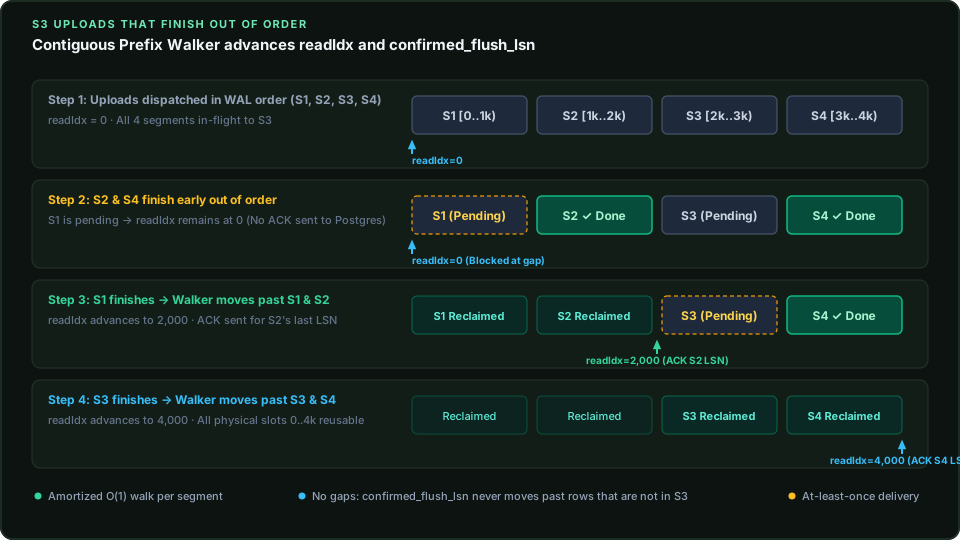
At step 10, event e9 is written to buffer[0], the slot e1 used before.
Its position is 8, and 8 % 8 = 0.
The ring at production size #
The next figure uses the defaults: 4 workers, 1,000 events per segment, and 8,000 slots. Slow PUT delays one upload, so later segments finish but wait behind it. S3 stall stops all uploads, so the ring fills and the replicator blocks.
1.2 ms. The receiver and walker logic match the source code.TestRingCapacity runs the WAL Cake ring with a stand-in uploader that sleeps for
7 ms plus a PUT time from the same lognormal (p50 100 ms). With four
workers it sustains about 35,500 events/s, against an ideal of about 36,000.
A variant with three workers, a p50 of 200 ms, and a 1.2 ms encode kept up
with 14,000 events/s.
What “mutex-free” means #
Add uses no mutex. It has one writer and atomic counters, only the writer
fills slots, and only workers and the walker read them. The tracker takes a
mutex a few times per segment, so a few times per 1,000 events. Go channels lock
internally, and a full ring blocks the replicator. So the system is not
lock-free. This does not limit throughput, because Add takes about 11 ns.
The purpose of the ring is to keep the ACK in order.
Parquet: small files #
Each Parquet file has one row group and seven columns: table, operation,
timestamp, lsn, before, after, and commit_time. before and after
hold the old and new row as JSON, and are null when that image does not exist:
an insert has no before, and a delete has no after. NUMERIC values are
written as JSON numbers with their exact digits, so 9999999999999999.99
stays 9999999999999999.99. All columns use ZSTD compression at level 3.
The test fixture has 1,000 events across 12 tables, a third each inserts, updates, and deletes. Its file is 13,465 bytes, and the two JSON columns are 90% of that.
Benchmarks of the WAL Cake code, three to five runs each:
| Step | Time | Allocated |
|---|---|---|
Ring Add |
about 11 ns per event | 0 B |
| Parse and decode one insert (five columns) | about 0.5 µs per event | 760 B |
| Write 1,000 events to Parquet | 1.17–1.20 ms per batch | 2.7–2.9 MB |
The Parquet library, arrow-go v18.2.0, creates a new ZSTD encoder for every
page it compresses, and each encoder allocates about 18 MB. A 1,000-event file
has one page per column plus two dictionary pages, so with the library’s own
codec the fixture takes about 6.5 ms and 170 MB per batch. WAL Cake registers a
ZSTD codec that reuses encoders from a sync.Pool. It writes exactly the same
bytes, and a test checks that.
The S3 upload and its key #
A segment can hold rows from two days around midnight. The processor checks
every event’s commit date and makes one PutObject call per run of equal
dates. The key is:
namespace/YYYY/MM/DD/<decode-time-µs>-<seq>.ZSTD.parquet
- The folder is the UTC date the transaction committed, from the
BEGINmessage. It does not depend on when WAL Cake decoded the row, on a replay, or on the server’s time zone. - The file name is the last event’s decode time in microseconds, plus a sequence number that is unique within the process. The decode time alone is not unique: events decode in well under a microsecond, so two files in one folder can end on the same microsecond.
After a crash, Postgres sends the same rows again. They decode at a new time, so they get a new key, and S3 now has two files with the same rows. Step through it in the figure, then switch to an LSN-based key.
An LSN-range key with an If-None-Match conditional write11 would
make a replayed segment a no-op, but only when the replay cuts exactly the same
segments. It often does not. A segment cut by the 30 s timer can have
different boundaries after a restart. A segment that ends inside a transaction
makes Postgres resend the whole transaction, which shifts every later boundary.
And a COPY writes up to 1,000 rows in one WAL record, so they share an LSN,
and an LSN range does not name a unique set of rows. A table format such as Iceberg handles deduplication
better, so WAL Cake leaves it to the reader.
If processing fails, the worker retries the whole segment, up to three
attempts, waiting 2 s and then 4 s. It reports the segment as done only
after an attempt succeeds.
Shutdown #
On SIGTERM, the ring stops taking events. It sends the last partial segment,
lets the workers finish their uploads, and moves the cursor over everything
that finished. Workers use a context that shutdown does not cancel, so an
upload is never cut off halfway. Then main stops the replicator, which sends
one final status update with the latest acked position before it closes the
connection.
After a deploy, Postgres resends at most the transaction that the last segment ended in. A crash, such as an OOM kill or a lost node, replays everything after the last status update.
How it is tested #
The tests are in the repository. The ones that need Postgres run when
WALCAKE_TEST_PG is set.
- Ring state machine.
rapidgenerates random sequences of events and random completion orders against the ring code. After every step, the ACK must be the LSN of an event inside the finished prefix, andreadIdxmust equal the model’s prefix. At the end, the drain must cover every admitted event. - Ring stress. 200,000 one-event segments finish concurrently. The ring must reach the last event without stalling.
- Processor property. Random commit times around midnight, in several time zones, with decode times that share microseconds. Each event must be uploaded exactly once, in order, one UTC commit date per file, under the right folder, with no key used twice.
- Replicator integration. Back-to-back commits followed by a restart; a killed walsender; a failing slot query; and the final status update on shutdown.
- Whole pipeline state machine. The production replicator, ring, processor, and
Parquet writer, with an S3 fake that fails each file once at random and adds
delays.
rapidgenerates histories of single-row and multi-row transactions,COPY, back-to-back commits, updates, deletes, rollbacks, killed walsenders, crashes, and graceful restarts. After recovery, every committed change must be in S3 with its exact values, no rolled-back row may be, every row must be in the folder for its commit date, and the slot must never have moved backwards.
To check that the pipeline test can fail, I pointed commit events 26 bytes past the end of the commit record. The state machine found a lost insert. The current code passes 25 random histories, and 5 more under the race detector.
What can still go wrong #
None of these lose a committed row.
Replays #
- Crash after a successful upload. The slot has not moved, so Postgres resends the rows and a second file holds them.
- Segment ends inside a transaction. The ACK is a change LSN, so after a restart Postgres resends the whole transaction, including rows already in S3.
- Upload fails three times.
log.Fatalexits the process, and the slot replays everything after the last ACK.
Readers of the lake should expect duplicates, and deduplicate on table,
lsn, operation, and the row’s key.
Stalls and reconnects #
- The ring is full. The receiver waits for free space,
eventsChfills, and the replicator blocks. After a minute, the readiness check fails. - The replicator is blocked for a long time. It cannot send status
updates while it is blocked, so Postgres drops the connection after
wal_sender_timeout(60 s by default). When the ring drains, WAL Cake reconnects from the slot. - The walsender dies or the primary fails over. The session ends, and WAL Cake reconnects with backoff. The readiness check fails until it streams again.
The buffers are large enough only for short delays. At 10,000 events/s with the defaults, the
ring holds 0.8 s of events and eventsCh another 0.4 s. Part of the ring
is always taken by in-flight segments, so a longer S3 outage pauses
replication, and WAL builds up on the primary.
Changes not captured #
TRUNCATEis logged and not written to the lake.- An unchanged TOASTed value is stored as the string
"<TOAST>", because pgoutput does not send it.
Takeaways #
- Advance the replication slot only past rows that are already in S3.
- Only encode and upload can run in parallel, and those steps take most of the time.
- Record every segment before it starts, and move the cursor only over finished segments. Out-of-order uploads then give one ordered ACK.
- Every LSN the consumer might send must be safe to confirm: the change LSN for a row, and the commit record’s end for a commit.
- Give the ring room for one more batch per worker, and wake the writer when space frees up, so the workers stay busy.
- Split day folders by the commit time from
BEGIN. - Property tests over whole histories (crashes, restarts, back-to-back commits, bulk loads) check the one rule directly.
-
https://debezium.io/documentation/reference/stable/connectors/postgresql.html ↩︎
-
https://debezium.io/documentation/reference/stable/operations/debezium-server.html ↩︎
-
https://docs.aws.amazon.com/dms/latest/userguide/CHAP_Target.S3.html ↩︎
-
S3 PUT latency benchmark, 500 KB objects, eu-north-1, 100 samples ↩︎
-
Postgres streaming replication protocol: standby status update ↩︎
-
https://www.postgresql.org/docs/current/view-pg-replication-slots.html ↩︎
-
https://www.postgresql.org/docs/current/protocol-logicalrep-message-formats.html ↩︎
-
https://docs.aws.amazon.com/AmazonS3/latest/userguide/conditional-writes.html ↩︎