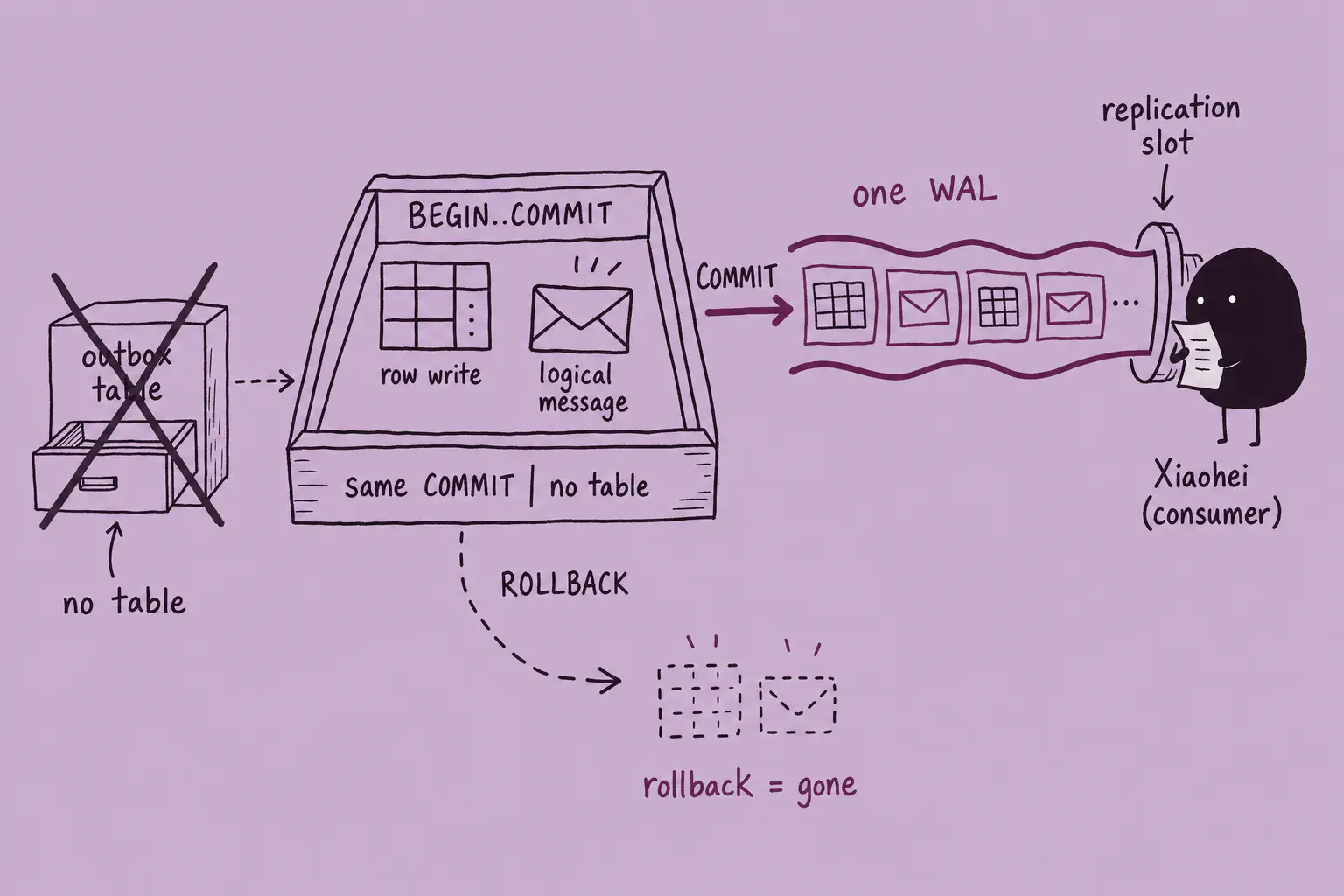
The idea #
Postgres’ replication can already carry your application’s events: no separate outbox table, polling loop, or cleanup job.
The outbox pattern needs three things: durability, order, and resumable delivery after a consumer disconnects. Every database already provides them, for replication. To keep a standby in sync, the database writes every change to a write-ahead log, ships those bytes to replicas in order, and tracks how far each replica has caught up.
Put that way, the outbox table is a second copy of replication, built
in application code on the same database: its own polling loop, its own
high-water mark (processed = true), its own cleanup job. The database
underneath already solves this.
Can the application emit its own events into that replication stream?
Postgres has shipped this since 9.6 (September 2016)1.
pg_logical_emit_message writes a blob into the WAL atomically with the
surrounding transaction; the same logical decoding that powers logical
replication reads it on the other end. The producer call is one line:
// pkg/outbox/producer/producer.go
sqlQuery := "SELECT pg_logical_emit_message(true, $1, $2::bytea)"
err = a.conn.Exec(ctx, sqlQuery, a.prefix, protoBytes)
Roll back and the message is never delivered; commit and it ships
through the WAL like any replicated change. The replication slot’s
confirmed_flush_lsn holds the bookkeeping the outbox table would
hold, so there’s no separate table, index, or vacuum job.
This post walks factlib2 — the Go library we ship at FamPay — and its consumer OwlPost line by line: producer, consumer, ack pipeline, trace propagation, and where it hits its limits.
1. The dual-write fallacy #
The first attempt:
func CreateUser(ctx context.Context, u User) error {
    if err := db.Save(ctx, u); err != nil {
        return err
    }
    return kafka.Produce(ctx, "user.created", u)
}
These few lines hide one failure mode: the DB commit lands but the event never reaches Kafka. It happens two ways:
- Kafka returns an error. The user exists in your DB, but downstream services never hear about it. The retry budget on the client expires; the request returns 500; the user retries and now you have two users (or one user and a UNIQUE-violation, depending on your schema). Either way, your invariants are broken.
- The process dies before the Kafka call. OOM, kill -9, panic, the kernel reaps you because the K8s node was draining. Same outcome, no error to log.
The bug is structural: no atomic operation spans your database and your message broker. (Kafka transactions per KIP-983 don’t help: they bound a producer’s writes across Kafka topics, not across Kafka and Postgres.) The fix: make event emission part of the same atomic write as the business data. That’s the outbox pattern.
2. The outbox table is almost right #
The standard outbox table:
BEGIN;
  INSERT INTO users (id, ...) VALUES (...);
  INSERT INTO outbox (id, aggregate_type, payload, created_at, processed)
  VALUES (gen_random_uuid(), 'user', '{...}'::jsonb, now(), false);
COMMIT;
A separate process polls:
SELECT id, aggregate_type, payload
FROM outbox
WHERE processed = false
ORDER BY created_at
LIMIT 100;
For each row it produces to Kafka, then:
UPDATE outbox SET processed = true WHERE id = ANY($1);
-- or
DELETE FROM outbox WHERE id = ANY($1);
The trade-off is the ongoing maintenance it adds.
The polling-latency / scan-cost tradeoff #
Poll every 100 ms and lag stays ~100 ms, at the cost of 864,000 SELECT scans per day per worker even when no events exist. Poll every 5 s and you add 5 s of p99 latency to every downstream. No good answer; 1 second is the usual compromise.
Vacuum, indexes, and cleanup #
UPDATE outbox SET processed = true writes a new row version; the old
tuple dies and waits for autovacuum. You need a partial index:
CREATE INDEX outbox_unprocessed_idx ON outbox (created_at) WHERE processed = false;
It makes that update not-HOT (Heap-Only Tuple; the predicate change kicks the row out of the index), so index bloat tracks table bloat. At 10K events/sec:
10,000 inserts/sec      → 10K live rows added per second
+ 10,000 updates/sec    → 10K dead rows per second
                        → vacuum has to reclaim ~864M dead tuples/day
DELETE instead of UPDATE just trades the update for a tombstone:
same bloat, same vacuum. The table only shrinks when autovacuum keeps up
with your inserts, which usually means tuning
autovacuum_vacuum_scale_factor down to ~0.01 and
autovacuum_vacuum_cost_limit up to 5000 for this table. And it stays
unbounded without a cleanup job:
DELETE FROM outbox WHERE processed = true AND created_at < now() - interval '7 days';
Run that on a 10 GB table at peak and you spike p99s; the safe shapes are
a chunked delete (LIMIT + pg_sleep) or partition-by-day +
DROP PARTITION. Both are extra code, alerts, and runbooks.
Polling vs change-data-capture #
The other option is Debezium tailing the WAL for INSERTs on
outbox. Solid: no polling, ~10 ms latency, row-level semantics. The
cost is running Debezium: a JVM process with Kafka Connect and a schema
registry. Fine if you’re already on that stack, heavy if you’re not.
That path runs INSERT → WAL → Kafka Connect → Kafka, with a schema registry alongside. The event is in the WAL the moment you commit; the next section reads it straight from there, dropping the table and the Connect tier.
3. pg_logical_emit_message
#
The function signature4:
pg_logical_emit_message(
    transactional boolean,
    prefix        text,
    content       text   [, flush boolean DEFAULT false]
) → pg_lsn

pg_logical_emit_message(
    transactional boolean,
    prefix        text,
    content       bytea  [, flush boolean DEFAULT false]
) → pg_lsn
It emits a text or binary logical-decoding message that plugins receive
through WAL. transactional = true makes it visible to decoders only on
COMMIT; false writes immediately. factlib uses transactional = true,
so the surrounding COMMIT carries the flush.
Three properties matter:
- Atomic with the surrounding transaction. If you
ROLLBACK, the message is never delivered.5 Same guarantee as the outbox table, no table needed. - Decoded by
pgoutput/wal2jsonlike any row change. SameSTART_REPLICATIONconnection, sameconfirmed_flush_lsn. - Zero on-disk table footprint after WAL recycling. Bytes live
in WAL until every replication slot has decoded past them (each
slot’s
restart_lsnmarks the oldest WAL it still needs, so a checkpoint recycles anything below the minimum), then they recycle like any other WAL record. No vacuum, no bloat, no cleanup job.
This is not Debezium-style row-level CDC: we are not decoding row
writes on an outbox table. We are inserting an application-defined
message into the same WAL the database uses for replication, and
decoding only that. (The underlying logical-decoding framework went
GA in 9.4; pgoutput landed in 10 alongside built-in logical
replication.)
4. How factlib emits #
factlib’s producer (pkg/outbox/producer/producer.go) is 99 lines
end-to-end. The hot path is Emit(), reproduced below with the
per-error metrics.EmitFailures.WithLabelValues(...) calls collapsed:
// pkg/outbox/producer/producer.go
func (a *PostgresAdapter) Emit(ctx context.Context, fact *common.Fact) (string, error) {
    if err := fact.Validate(); err != nil {
        return "", errors.Wrap(err, "failed to validate fact")
    }
    eventId, err := uuid.NewV7()
    if err != nil {
        return "", errors.Wrap(err, "failed to generate event ID")
    }
    outboxEvent := &pb.OutboxEvent{
        Id:            eventId.String(),
        AggregateType: fact.AggregateType,
        AggregateId:   fact.AggregateID,
        EventType:     fact.EventType,
        Payload:       fact.Payload,
        Metadata:      fact.Metadata,
        TraceInfo: &pb.TraceInfo{
            TraceId: fact.TraceInfo.TraceId,
            SpanId:  fact.TraceInfo.SpanId,
            Metadata: map[string]string{
                "parent_op":  fact.TraceInfo.ParentOp,
                "is_sampled": fact.TraceInfo.IsSampled,
            },
        },
        CreatedAt: time.Now().UTC().UnixNano(),
    }
    protoBytes, err := proto.Marshal(outboxEvent)
    if err != nil {
        return "", errors.Wrap(err, "failed to marshal proto event")
    }
    sqlQuery := "SELECT pg_logical_emit_message(true, $1, $2::bytea)"
    err = a.conn.Exec(ctx, sqlQuery, a.prefix, protoBytes)
    return outboxEvent.Id, err
}
WithTxn(txn) binds the producer to a transaction by construction.
Right above the function:
func (a *PostgresAdapter) WithTxn(txn postgres.SQLExecutor) (postgres.OutboxProducer, error) {
    return &PostgresAdapter{ conn: txn, logger: a.logger, prefix: a.prefix }, nil
}
Application code:
func CreateUser(ctx context.Context, db *pgxpool.Pool, u User) error {
    return pgx.BeginFunc(ctx, db, func(tx pgx.Tx) error {
        if _, err := tx.Exec(ctx, "INSERT INTO users ...", u.ID, ...); err != nil {
            return err
        }
        producer, _ := factlibProducer.WithTxn(postgres.GetPgxTxn(tx))
        fact, _ := common.NewFact("user", u.ID, "user.created", payloadBytes, nil)
        fact.TraceInfo = &common.TraceInfo{}  // required; Emit dereferences it
        _, err := producer.Emit(ctx, fact)
        return err
    })
}
The producer shares the pgx.Tx with the business INSERT. There
is no way to call Emit outside a transaction, and no way for Emit
to commit on its own.
UUIDv7 for event IDs. Time-sortable, 48-bit millisecond timestamp prefix, then random bits. Two reasons it matters here over UUIDv4:
- B-tree index locality on the consumer side. Whatever ledger the consumer keeps for “events I have seen” — Postgres, Mongo, Cassandra — sorts inserts in time-near order, which keeps the right side of the btree hot and the rest cold. v4 inserts are uniformly random and bloat the btree over time.
- Free time ordering. Sort events by ID and you get an
approximate timeline without a separate
created_atindex. Useful for replay debugging.
Either v7 or ULID6 gives this (both are 128-bit with a leading
millisecond timestamp); we pick v7 because it’s part of the UUID
standard and round-trips through any Postgres / pgx uuid column without
custom serde.
One marshal, one SQL call. No retry inside the emit. If the
SELECT pg_logical_emit_message(...) fails, the surrounding
transaction is poisoned and rolls back, and the caller decides whether
to retry the whole business operation.
Latency observability. Each emit records the
factlib_event_processing_seconds histogram; the SELECT itself runs in
microseconds.
Same emit in Python. factlib has a sibling in python/factlib/ with
the same SQL and protobuf bytes:
# python/factlib/index.py
def emit(self):
    cursor = connection.cursor()
    try:
        sql_query = "SELECT pg_logical_emit_message(true, %s, %s::bytea)"
        cursor.execute(sql_query, (self._prefix, self._event.SerializeToString()))
    finally:
        cursor.close()
The Django version uses django.db.connection, picking up the in-flight
ORM transaction as long as emit() runs inside an atomic() block. Once
the wire format is “bytes in WAL with a prefix”, any language can emit and
any can consume: a Django service emits a payments-user event, OwlPost
(Go) ships it to Kafka, downstream consumers in any language read the same
proto. The producer language never enters the picture downstream.
To verify an emit landed in WAL, create a slot before running the
producer (cmd/demo/main.go, which needs wal_level = logical and
DATABASE_URL); a slot only sees changes after its creation point. Then
peek:
-- before: table, publication, slot
CREATE TABLE users (id text PRIMARY KEY, email text);
CREATE PUBLICATION demo_pub;
SELECT pg_create_logical_replication_slot('demo_peek', 'pgoutput');

-- run the producer (INSERT + emit), then peek at the bytes:
SELECT lsn, encode(data, 'hex')
FROM pg_logical_slot_peek_binary_changes(
    'demo_peek', NULL, NULL,
    'proto_version', '1', 'publication_names', 'demo_pub', 'messages', 'true'
);

-- cleanup:
SELECT pg_drop_replication_slot('demo_peek');
DROP PUBLICATION demo_pub;
DROP TABLE users;
5. How OwlPost consumes #
OwlPost (cmd/owlpost/) opens a logical-replication connection,
filters the WAL for our prefix, deserialises the protobuf, ships to
Kafka. The connection setup needs two flags:
// pkg/postgres/wal.go — NewWALSubscriber
replUrl := fmt.Sprintf("%s?replication=database", cfg.DatabaseURL)
replConn, err := pgconn.Connect(ctx, replUrl)
?replication=database enters replication mode (it can still run
regular SQL, unlike replication=true). factlib opens two
connections because once you fire START_REPLICATION, that socket
only streams CopyData; you can’t run queries on it.
replConn does streaming; queryConn does the
SELECT EXISTS(SELECT 1 FROM pg_replication_slots ...) bookkeeping.
Setting up the slot #
Two one-time, idempotent operations that pkg/postgres/wal.go runs
on every boot (%s is fmt.Sprintf interpolation):
-- ensurePublication
CREATE PUBLICATION %s;
-- ensureReplicationSlot
SELECT pg_create_logical_replication_slot('%s', 'pgoutput');
A publication is a set of tables whose row changes get streamed;
we don’t care about row changes, just logical-decoding messages, but
pgoutput requires a publication to exist before it starts. We make
an empty one.
A replication slot is the durability primitive. It holds WAL until the consumer acks past that LSN (log sequence number, a byte offset into the WAL). This is at-least-once for free: if OwlPost crashes for an hour, WAL accumulates for an hour and we resume exactly where we left off. One risk to watch: a slot whose consumer never returns pins WAL until the disk fills.
Starting replication #
// pkg/postgres/wal.go — startReplication
err = pglogrepl.StartReplication(ctx, w.replConn, w.cfg.ReplicationSlotName, w.xLogPos,
    pglogrepl.StartReplicationOptions{
        PluginArgs: []string{
            "proto_version '1'",
            fmt.Sprintf("publication_names '%s'", w.cfg.PublicationName),
            "messages 'true'",   // ← the important one
        },
    })
messages 'true' is a pgoutput plugin arg (added in PG 147)
that tells it to decode logical-decoding messages alongside row
changes. Without it, pg_logical_emit_message calls are silently
dropped on the subscriber side, with no error to tell you why.
w.xLogPos is the start position. On every boot it’s the slot’s
confirmed_flush_lsn:
SELECT confirmed_flush_lsn FROM pg_replication_slots WHERE slot_name = $1;
That single column is the entire durability state of the consumer.
The receive loop #
for {
    rawMsg, err := w.replConn.ReceiveMessage(receiveCtx)
    switch msg := rawMsg.(type) {
    case *pgproto3.CopyData:
        switch msg.Data[0] {
        case pglogrepl.PrimaryKeepaliveMessageByteID:
            // keepalive; reply if requested
        case pglogrepl.XLogDataByteID:
            xld, _ := pglogrepl.ParseXLogData(msg.Data[1:])
            newXLogPos := xld.WALStart + pglogrepl.LSN(len(xld.WALData))
            logicalMsg, _ := pglogrepl.Parse(xld.WALData)
            w.processLogicalMessage(ctx, logicalMsg, newXLogPos)
        }
    }
}
Two message types matter:
- PrimaryKeepalive. Postgres sends one on a cadence governed by
wal_sender_timeout(default 60 s, keepalive interval = timeout/2 = 30 s) even when the WAL is idle. The server can request a reply, in which case OwlPost echoes back its currentWALWritePositionso the server doesn’t tear down the connection. OwlPost’s own tick is faster (standbyMessageTimeout := time.Second * 5inpkg/postgres/wal.go), so we send a status update every 5 s regardless. - XLogData. Real WAL bytes. We parse them, compute
newXLogPos := xld.WALStart + LSN(len(xld.WALData)), and pass that LSN through with the decoded message intoprocessLogicalMessage. The receive loop does not advancew.xLogPositself; the LSN rides on each event and only updatesw.xLogPoswhen the ack pipeline hears back from Kafka.
processLogicalMessage filters by prefix with a type switch:
func (w *WALSubscriber) processLogicalMessage(
    ctx context.Context,
    msg pglogrepl.Message,
    xLogPos pglogrepl.LSN,
) {
    if ldm, ok := msg.(*pglogrepl.LogicalDecodingMessage); ok {
        if ldm.Prefix == w.cfg.OutboxPrefix {
            w.handleMessage(ctx, ldm.Content, xLogPos)
        }
    }
}
We decode the WAL stream of an entire database but only act on messages matching our prefix. Other emitters (other services, other prefixes) on the same database fan out the same way: each consumer subscribes with its own prefix and ignores the rest. The prefix is the routing key.
Kafka adapter #
OutboxConsumer.RegisterHandler(prefix, handler) wires one handler per
prefix (and an ack callback). For OwlPost the handler is the Kafka
adapter:
// pkg/outbox/consumer/kafka.go — KafkaEventHandler
topic := fmt.Sprintf("%s.%s", event.OutboxPrefix, event.Outbox.AggregateType)
key := []byte(event.Outbox.AggregateId)
value, _ := proto.Marshal(&event.Outbox)
headers := map[string]string{
    "event_id":   event.Outbox.Id,
    "event_type": event.Outbox.EventType,
    "LSN":        event.XLogPos.String(),
}
producer.Produce(ctx, topic, key, value, headers)
Three details:
- Topic =
prefix.aggregateType. Alluser.*events emitted with prefixpayments-userland in thepayments-user.usertopic. Topic proliferation is bounded by aggregate type, not event type; you filter individual event types on the consumer side. - Key = aggregateId. Kafka hashes this key to a partition, so
all events for
aggregate_id = "user-12345"land on the same partition in WAL order. Per-aggregate ordering is preserved end-to-end, cross-aggregate isn’t. headers["LSN"]. The LSN rides with each message so OwlPost’s ack callback can feed it back to advance the slot. Downstream consumers don’t need it; it’s there so any Kafka message can be traced back to its exact WAL position on the publisher.
6. Distributed tracing through the WAL #
Trace context across an outbox boundary has to be passed explicitly, or the producer’s Sentry / OTel span ends at the database write and a fresh, disconnected one starts at the Kafka consume, which makes incident replay harder. factlib carries it inside the protobuf:
// pkg/proto/outbox.proto
message TraceInfo {
  string trace_id = 1;
  string span_id  = 2;
  map<string, string> metadata = 3;   // parent_op, is_sampled
}
The producer fills TraceInfo from its tracer (the Python client lifts
the active Sentry span off the hub; the Go side is symmetric). On the
consumer, KafkaEventHandler copies those fields into Kafka headers, so
Service B opens a child span with the same trace ID and Sentry / Jaeger /
Tempo stitch the two into one waterfall. Same protobuf in every language,
so polyglot fan-in needs no extra work.
7. Crash safety: the LSN ack pipeline #
The LSN ack pipeline guarantees every committed event reaches Kafka at least once under failure, across four scenarios.
Scenario 1: the happy path #
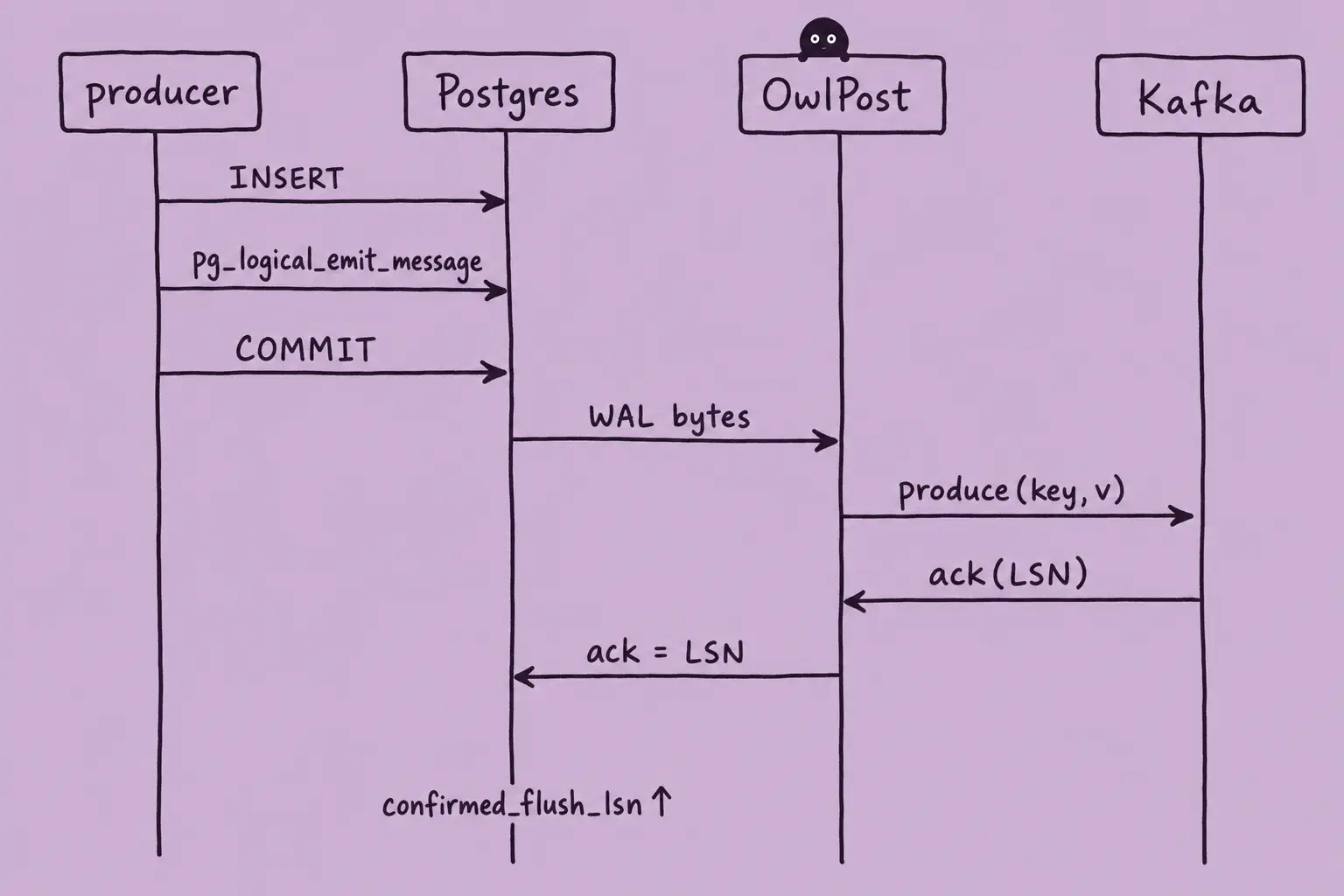
OwlPost produces to Kafka asynchronously (franz-go, acks=all, idempotent
producer), so each partition stays ordered and a success callback means the
record is durably replicated. It does not advance the slot on each ack, and
it never advances to the latest ack: a later event can ack while an
earlier one is still in flight on another partition. It advances to the
contiguous acked prefix instead.
The single WAL reader hands events to the producer in LSN order, so
pending stays sorted. Each Kafka success marks one done; we then advance
over the longest gap-free run from the front:
// pkg/postgres/wal.go — advance over the contiguous acked prefix
func (w *WALSubscriber) onKafkaAck(lsn pglogrepl.LSN) {
    // NOTE: pending is an unbounded slice today; a fixed ~1000-slot ring
    // buffer would cap the in-flight set and back-pressure the WAL reader.
    w.mu.Lock()
    w.acked[lsn] = true
    for len(w.pending) > 0 && w.acked[w.pending[0]] {
        w.safe = w.pending[0]          // highest LSN with no gap below it
        delete(w.acked, w.pending[0])
        w.pending = w.pending[1:]
    }
    w.mu.Unlock()
}

// 1s tick:
w.SendStandbyStatusUpdate(w.safe)      // everything <= safe is durable
This keeps the pipeline full, no draining. Two properties fall out:
- A gap pins the slot. If an event is slow or its produce fails, its
LSN never leaves the head of
pending, sosafe(andconfirmed_flush_lsn) stops there. A stuck broker becomes back-pressure, not skipped events. Pair it with slot-lag alerting. - Ack traffic collapses.
safeadvances on every ack but is only shipped to Postgres on a 1-second tick, so 10K acks/sec become oneSendStandbyStatusUpdate, four orders of magnitude less wire chatter.
The cost is a bounded replay window (events since the last shipped tick),
which the consumer dedupes on event.Id.
Scenario 2: producer crash mid-transaction #
This is what transactional=true is for: logical decoding emits a
transaction’s records only on COMMIT. A panic before COMMIT means
ROLLBACK, so no commit record reaches the WAL and zero events leak,
same as the table-based pattern.
Scenario 3: consumer crash post-Kafka, pre-LSN-ack #
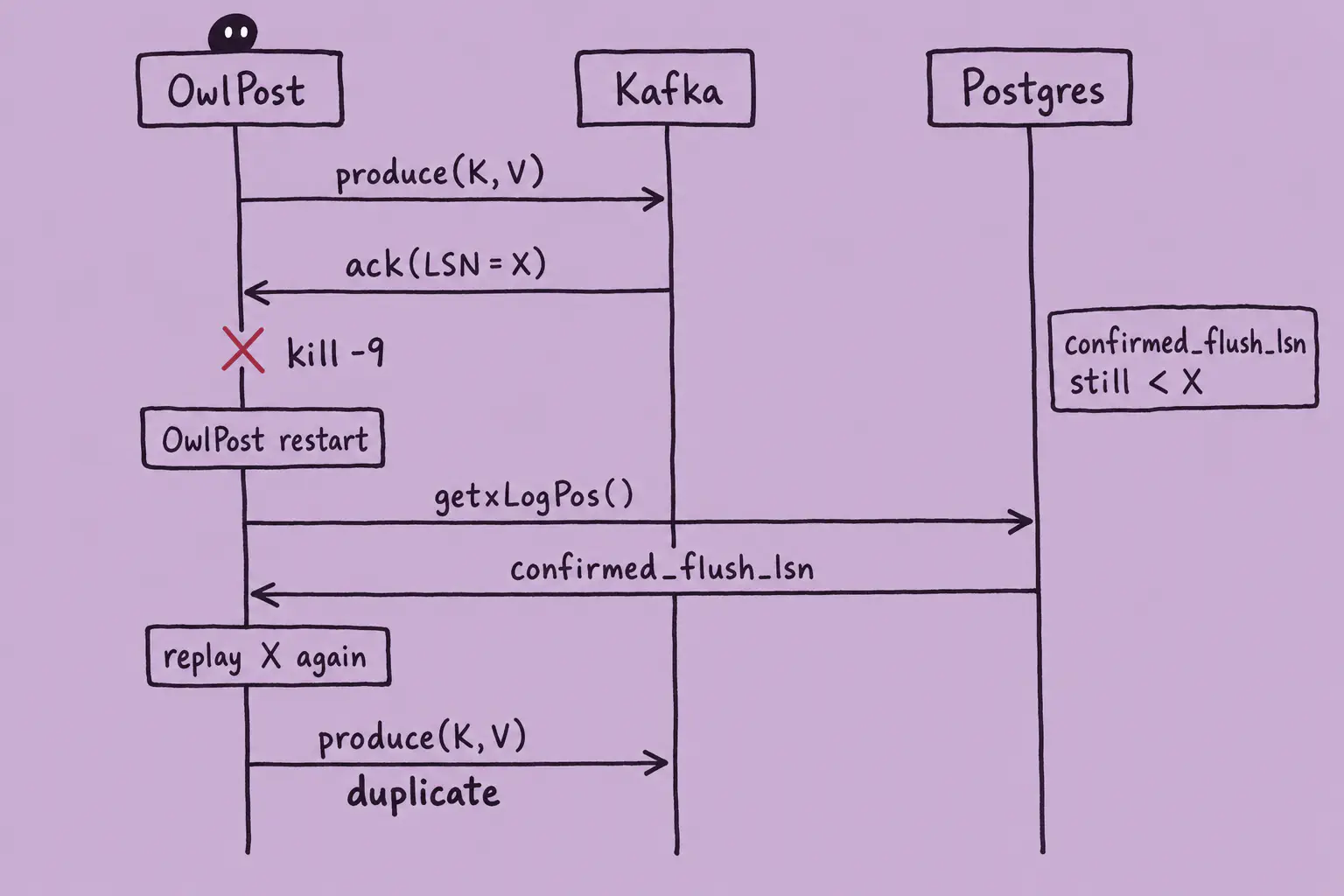
The same event is produced to Kafka twice, by design: this is at-least-once,
so the consumer must be idempotent. Dedupe on event.Id (a UUIDv7). For
durable dedup, INSERT ... ON CONFLICT DO NOTHING into a
processed_events(id uuid PRIMARY KEY, processed_at timestamptz) table you
TTL-prune; an in-memory LRU of recent IDs is a fine fast-path in front of
it, but only the table survives the restart that caused the duplicate.
A Bloom filter is the cheapest membership check, but it only errs toward
false positives — reporting an unseen event as already seen. So it can
confirm an event is new (definitely not in the set) but never that one was
already handled; keep the table as the authority.
Scenario 4: Kafka down for hours #
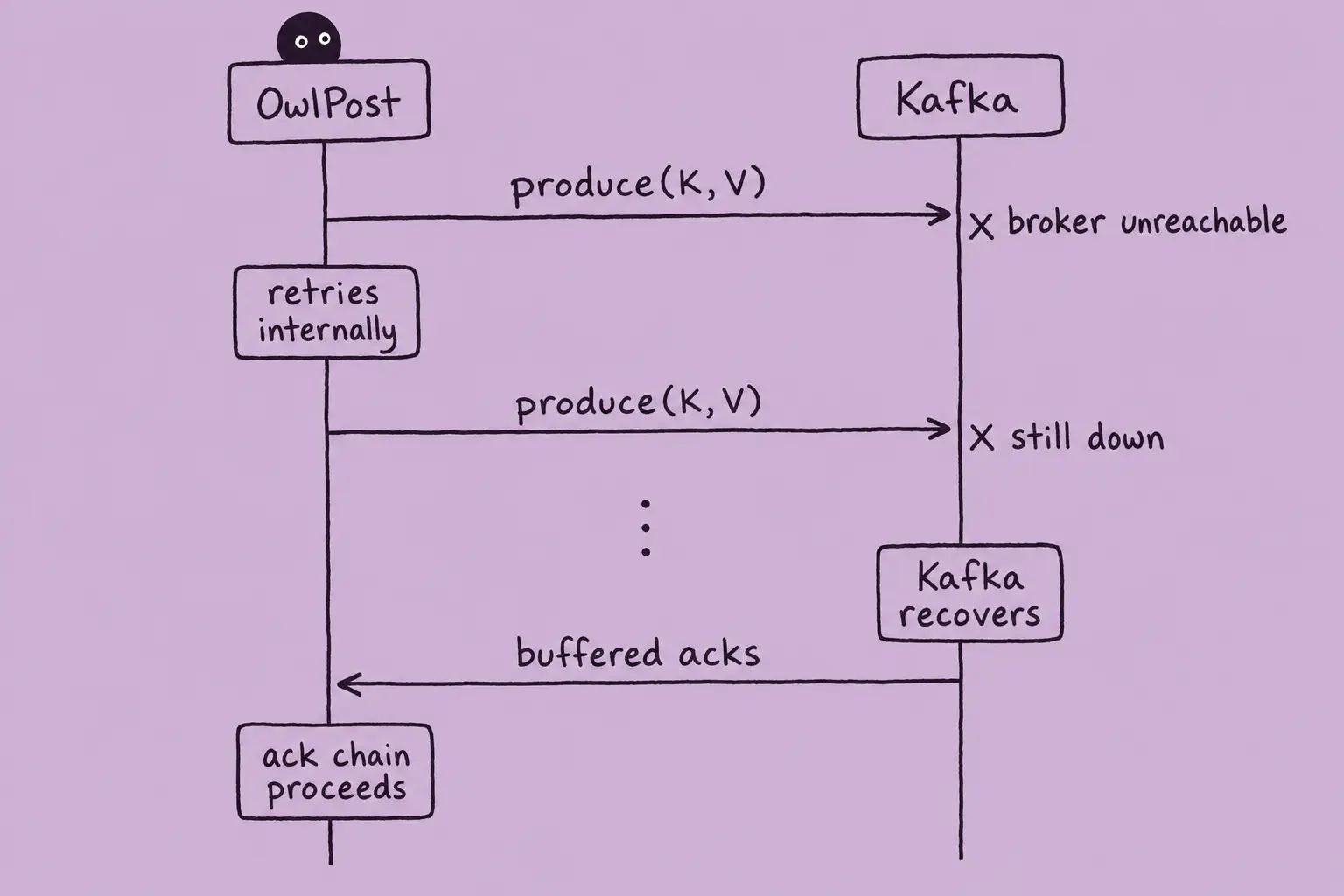
While Kafka is down, OwlPost reads up to 1000 events into the
w.events channel (a buffered Go channel; sends block past that),
plus whatever franz-go’s producer can buffer. Once both buffers are
full, the WAL receive loop stops draining and Postgres continues to
retain WAL behind the slot. The LSN never advances.
After ~hours, two things start to break:
-
WAL fills the disk. Postgres has no built-in alarm for “this replication slot is way behind.” You add it:
-- alert when ANY slot lags > 1 GiB. Don't filter by active=true:
-- a stuck slot whose consumer has died goes inactive, and that's
-- the most dangerous case (WAL still pinned, nobody draining).
SELECT slot_name, active,
       pg_size_pretty(
         pg_wal_lsn_diff(pg_current_wal_lsn(), confirmed_flush_lsn)
       ) AS lag_size
FROM pg_replication_slots;
We scraped this with a Postgres metrics exporter running custom queries — slot lag alongside integer-PK headroom and vacuum and index stats — and alerted at
> 1 GiB, paged at> 5 GiB. If it grows past your reserved disk, Postgres stops accepting writes, halting every writer in your fleet. Postgres 13+ hasmax_slot_wal_keep_size(default-1/ no limit) that invalidates a slot before disk fills; set it (e.g.10GB) so a stuck slot loses its WAL retention rather than wedging the cluster. -
The producer’s WAL emit latency stays unchanged. The producer doesn’t care that the consumer is slow. The dual-write fallacy doesn’t reappear because the producer’s only contract is “the bytes are in WAL.”
When Kafka recovers, OwlPost drains, WAL is reclaimed, and disk pressure drops without data loss.
8. Ordering & throughput #
Ordering #
- Per-aggregate ordering: strict. Kafka partition is keyed on
aggregateId. All events foraggregate_id = "user-12345"land on the same partition, in WAL emission order. The WAL itself is totally ordered, and Kafka’s per-partition order is preserved. - Cross-aggregate ordering: not guaranteed in Kafka. Two events for different aggregates may land on different partitions and be consumed in any order. Cross-aggregate ordering serialises everything, defeats partitioning, and hurts throughput; when you need it, make the related events share an aggregate.
The WAL itself preserves total order across all transactions on the publisher database. A single-partition consumer would expose that strict total order; the per-partition guarantee is usually enough.
One consumer is fine if it keeps up with your event rate; reach for more partitions only when you need the parallelism. Repartitioning a live topic reshuffles which keys map to which partition, so size for roughly a year of growth up front rather than reaching for it later.
Throughput — napkin math #
Each Emit is one extra SELECT pg_logical_emit_message(...) on top of
the business transaction. Three costs:
-
Function dispatch + arg copy. A few µs for the built-in C function (
pg_logical_emit_message_bytea); pgx copies thebyteapayload once into the network buffer (~hundreds of ns for 500 B). -
WAL append. One
XLOG_LOGICAL_MESSAGErecord. Its overhead is fixed and computable from the Postgres headers (xlogrecord.h8,replication/message.h9). For a 500 B payload with prefix"payments-user":XLogRecord header 24 B XLogRecordDataHeaderLong 5 B (payload >255 B) xl_logical_message header 24 B prefix (NUL-terminated) 14 B ("payments-user\0") payload 500 B ────────────────────────────────────── total 567 B per emitPlus the COMMIT’s
xl_xact_commitrecord (~34 B), so ~600 B amortised per event. -
Total round-trip. On Apple M3 Max10 (1 KB payload, BEGIN → INSERT → EMIT → COMMIT, 10K iters): emit
SELECTp50 12.8 µs (unix socket) / 21.9 µs (TCP loopback), p99 28 / 42 µs. Same-VPC TCP adds the cross-host RTT (~200–500 µs cross-AZ). Protobuf marshal of 500 B is ~5 µs, negligible.
At 10K events/sec:
WAL bytes   ≈ 600 B × 10,000  = 6 MB/sec
            ≈ 21 GB/hour
            ≈ 500 GB/day
A modern NVMe sustains 1–3 GB/sec sequential writes; the EBS gp3 volume
here did 574 MB/sec. At ~600 B per event the WAL is never the limit for
small events. What binds depends on payload size and how you commit.
Measured on a 16-core EC2 box (EBS gp3, durable synchronous_commit = on)11:
small events, one emit per commit    fsync-bound      ~25–70K emits/sec
small events, batched (~512/commit)  CPU / WAL locks  ~390K emits/sec
large events (≥100 KB)               WAL bandwidth    ~SSD write rate
A single connection does ~1,000 emits/sec, exactly the volume’s single-stream fsync rate. Concurrency, and especially batching several events into one transaction, amortise that fsync across many emits. Batch ~512 and you reach ~390K/sec durable, where the disk sits at 12% and the limit becomes CPU and WAL-insert locks rather than fsync. Only payloads above ~100 KB push WAL to the disk’s write rate. So 100K events/sec is comfortable on one node once you batch. Batching scales both sides: the producer groups emits into fewer commits, and the consumer batches WAL reads and fans the processing out across Kafka partitions or workers, trading strict global order for per-key order.
Cost breakdown vs the outbox table #
| Outbox table (poll) | factlib (logical msg) | |
|---|---|---|
| Producer SQL | 1 INSERT (heap tuple ~24 B header + payload + 2 index entries) | 1 SELECT (~600 B WAL) |
| Producer round-trips | 1 | 1 |
| Consumer query rate | 10/sec poll (100 ms) | 0 (push via WAL) |
| Index writes per event | 2 (PK + partial-on-processed) |
0 |
| Vacuum cost | proportional to event rate | none |
| End-to-end latency | poll interval (100 ms–5 s) | WAL flush + Kafka produce (single-digit ms on a same-VPC pgx connection, derived) |
| Consumer parallelism | N workers (SKIP LOCKED / partitioned table) |
1 reader per slot; fan out via Kafka |
The producer cost is roughly the same; the consumer side is where they
differ. The outbox table is wasteful to poll but parallelizes at the
database read: N workers with SELECT ... FOR UPDATE SKIP LOCKED, or a
partitioned table. A logical slot has exactly one reader, so factlib
parallelizes after Kafka instead.
Comparison #
| Approach | What it costs | What you get |
|---|---|---|
| Dual-write (DB then Kafka) | No atomicity: a crash between the two writes loses or duplicates events | Simplest to write |
| Outbox table + poller | A table, polling latency, and constant vacuum + cleanup | Atomicity on any database, simple mental model, parallel consumers |
| Outbox table + Debezium | Running Debezium (JVM, Kafka Connect, schema registry); table and cleanup remain | No polling (~10 ms), per-aggregate ordering, mature tooling |
| factlib (logical messages) | Postgres-only, one WAL reader (fan out via Kafka), slot-lag alerting | No table, index, vacuum, cleanup, or schema migration; per-aggregate ordering; trace context in the WAL |
Notes #
Cross-database transactions #
pg_logical_emit_message is per-database. If your business
transaction spans multiple Postgres clusters (write to A and B
atomically), you don’t have an atomic write to begin with, and
factlib doesn’t help. You need 2PC or a saga.
Schema evolution #
Standard protobuf evolution rules apply (additive optional fields, never re-use field numbers, never change types) and you need a shared schema registry across consumer languages. factlib doesn’t solve this problem, it just doesn’t make it worse, same as any protobuf-based event bus.
Long Postgres transactions #
With the proto_version '1' plugin arg factlib uses today, logical
decoding does not see a transaction’s records until COMMIT, so a 30-
second transaction blocks event delivery for 30 seconds. The
outbox-table pattern has the same property; the advice is the same:
keep transactions short, hoist long-running work outside the
transaction.
Newer pgoutput protocols help: v2 (PG 14) streams in-progress transactions; v3 (PG 15) adds two-phase commit; v4 (PG 16) adds parallel apply12. Switching factlib past v1 is deferred because it needs care around rolled-back streamed messages on the consumer.
Production gotchas #
max_wal_sendersandmax_replication_slotsdefault to 10. Twelve services each running their own consumer will exhaust them; bump both inpostgresql.confbefore you scale.- Slot-lag alerting is mandatory. Alert on
pg_replication_slotslag and cap it withmax_slot_wal_keep_size.
Further reading #
- Postgres docs:
logical decoding,
pg_replication_slots. - The classic outbox-pattern essay by Chris Richardson: microservices.io.
- Decodable on the same idea applied to CDC pipelines: Revisiting the Outbox Pattern.
- Debezium’s outbox-router (the Debezium-based variant of the same pattern): https://debezium.io/documentation/reference/stable/transformations/outbox-event-router.html.
pglogreplGo library: https://github.com/jackc/pglogrepl.
-
KIP-98 — Exactly Once Delivery and Transactional Messaging ↩︎
-
Rollback isn’t physically free: the
XLOG_LOGICAL_MESSAGErecord is written to WAL when the function runs, andROLLBACKonly adds an abort record on top. Logical decoding buffers the transaction and drops it on abort, so what you avoid is delivery, not the write — the bytes sit in WAL until normal recycling. The outbox table is the same shape: a rolled-backINSERTstill wrote a tuple and WAL that vacuum later reclaims. ↩︎ -
Measured on a local PostgreSQL 17 (
wal_level = logical,synchronous_commit = on), 10,000 iterations of BEGIN → INSERT →pg_logical_emit_message→ COMMIT timing the emitSELECT, over a unix socket and TCP loopback on an Apple M3 Max. ↩︎ -
Throughput measured on a 16-core EC2 instance (EBS gp3, ~574 MB/sec sequential write, single-stream
fdatasync~1,100/sec) running PostgreSQL 15 withwal_level = logical,synchronous_commit = on, over a unix socket. Load from a concurrent Go emitter (pgx, onepg_logical_emit_messageper commit unless batched), cross-checked againstpgbenchwithin ~2%. ↩︎