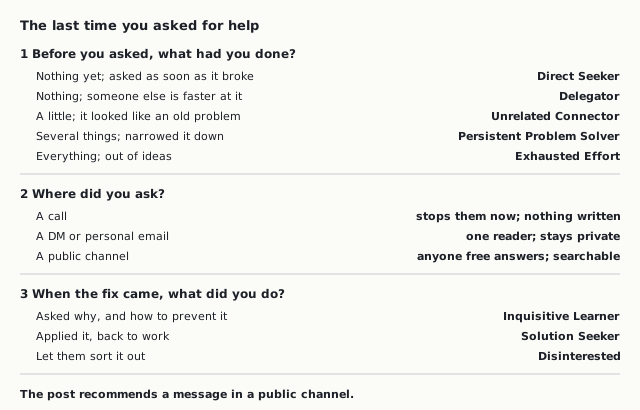
The first message someone sends when they are stuck tells you most of what they need from you. This post sorts help seekers into five types by how much they tried before asking, and into three types by how they take the fix. By the end, you should be able to identify the type of a message in a few seconds, give the help that type needs, and know where to ask so that one answer helps more than one person.
As a backend engineer, I’ve seen the same few patterns in how people ask for help. A pattern describes how someone asks in one moment. The same engineer can be a Direct Seeker on a busy Monday and a Persistent Problem Solver on Friday.
Types of Help Seekers #
The types differ in two things: the effort spent before asking, and the difficulty of the problem.
The Persistent Problem Solver #
Effort Level: High
Difficulty: High
They try several approaches before they ask, and they have often narrowed the issue down. They want confirmation or a new view. Their message explains what they tried and ends with a specific question.
The Exhausted Effort #
Effort Level: High
Difficulty: High
They have tried everything they can think of and failed. They ask as a last resort, hoping for the one hint that fixes it. Their message lists every attempt, often with visible frustration.
The Unrelated Connector #
Effort Level: High
Difficulty: Medium
They have solved related problems before but do not see how those connect to this one. They need someone to explain how the earlier problems relate to this one.
The Direct Seeker #
Effort Level: Low
Difficulty: Unknown
They ask as soon as they hit the problem, without trying first. They assume someone else has a ready answer, and they may not know how hard the problem is.
The Delegator #
Effort Level: Low
Difficulty: Low
They know the problem but prefer not to solve it. Someone else can do it faster, or they see it as outside their job. They take little part in the fix.
Reading the first message #
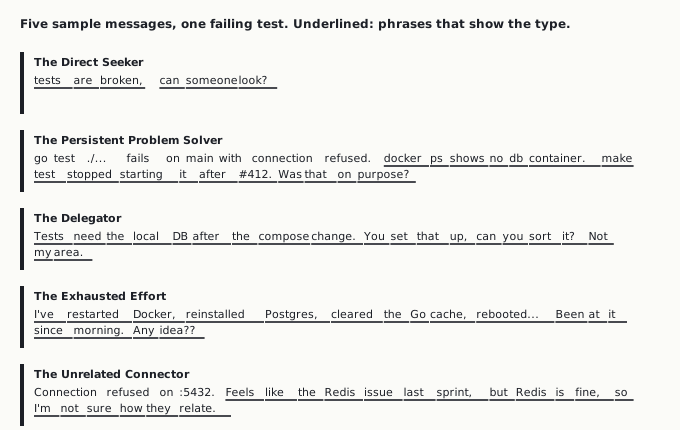
The type usually shows in the first message. Fig. 1 has five sample messages about the same failing test.
Reactions to Solutions #
After the fix arrives, what the person does next decides whether they will need the same help again.
The Inquisitive Learner #
They want to understand the fix so the issue does not come back. They ask how it works and ask clarifying questions.
The Solution Seeker #
They care only about the immediate issue. They want the fix and do not ask how it works, and they struggle to answer detailed questions about it.
The Disinterested #
They have no interest in the problem or the fix. They want it resolved fast, with as little involvement as possible.
Where to ask #
A phone or WhatsApp call needs the other person right now. They stop what they are doing, and the answer is not written down anywhere. A direct message or personal email does not interrupt anyone. Only one person sees it. If they are busy, you wait, and the answer stays private.
A message in a public channel avoids both problems. It does not force anyone to stop work. Anyone who is free can answer, and the answer stays searchable for the next person who hits the same problem.
Takeaways #
How someone asks tells you what they need. A persistent solver wants a second opinion. A direct seeker first needs someone to find out how hard the problem is. When you recognise the pattern, you can give that help. When you ask in public, more than one person can use the answer.
To find the type of your own last ask, answer the three questions in Fig. 2.